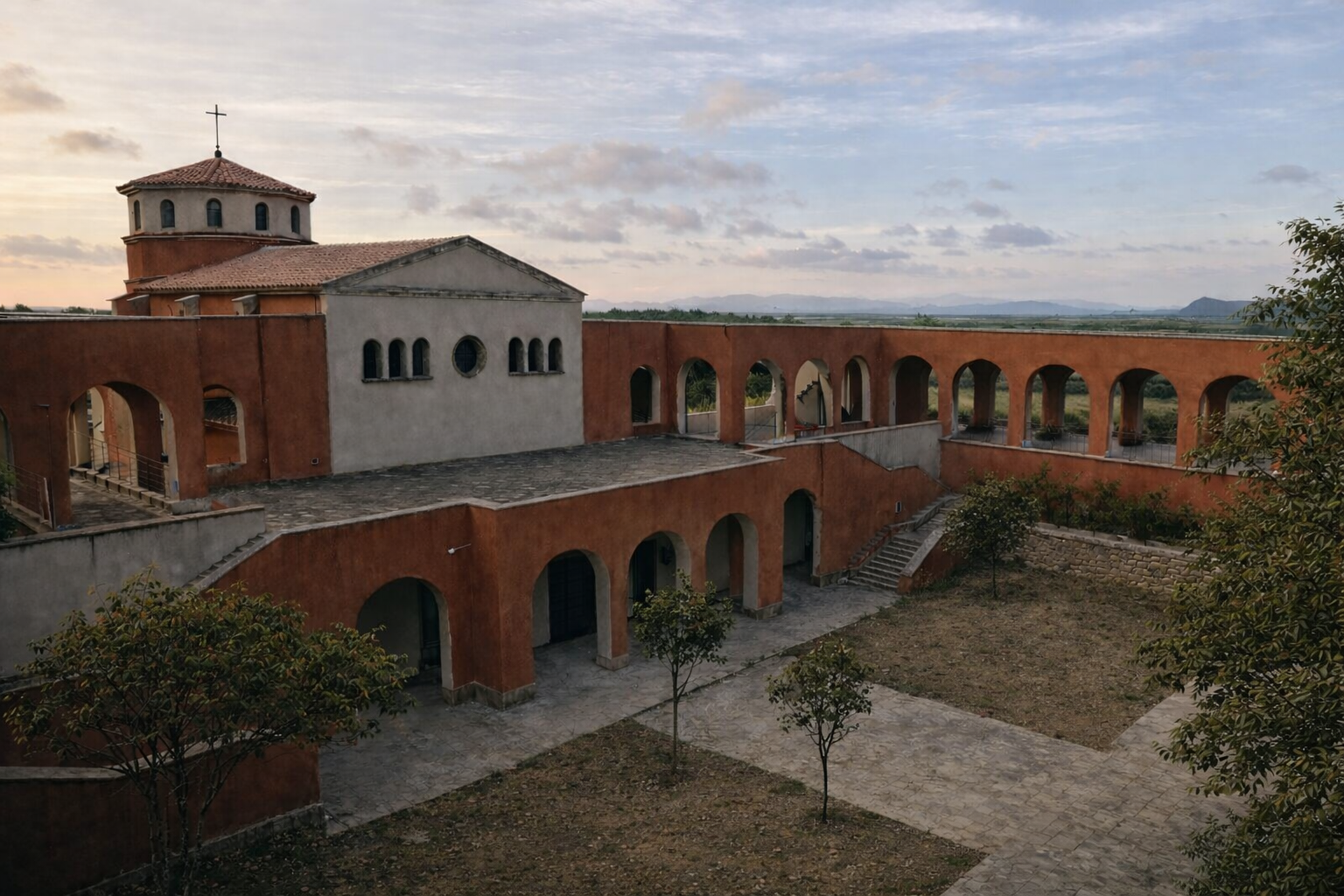

Some buildings don’t need ghosts to command respect. The Hospital del Tòrax (the “Sanatori de Terrassa” to locals) is one of them. It is enormous, stern, and has that “block” aesthetic that instantly puts your brain in movie mode.
But the good — and important — thing is to separate what is documented from what is merely told. Because its real history is intense enough on its own: it was born as a tuberculosis sanatorium in the 1950s and today it is part of the Parc Audiovisual de Catalunya, where films such as J. A. Bayona’s “A Monster Calls”, Jaume Balagueró’s “REC 2” and “REC 4” and Brad Anderson’s “The Machinist” have been shot.
The essentials in 30 seconds
| Facts (documented) | Dark legend (tales and rumors) |
|---|---|
| Opened on June 8, 1952 as the “Ciudad Sanatorial de Tarrasa”. | EVP recordings, “voices”, shadows, lights in the windows… endlessly repeated, zero serious evidence. |
| Designed in 1947. A building with 9 floors and 1,200 beds. | “Rituals”, forbidden zones, the usual “urbex” crowd + word of mouth. |
| Listed elements (1986 plan) and partial renovation in 2010 (central building, cloister and chapel). | The place becomes “cursed” mainly after its closure, once it stands empty and people start projecting. |
| In 2004 its conversion into the Parc Audiovisual is launched; there is a planning framework (PECA). | And when a place is also used for film shoots… everything strange “feels more real”. |
A building that needs no filters
It doesn’t matter whether you believe in these things or wave them off as nonsense. The Hospital del Tòrax makes you lower your voice. And there’s a reason: today it is (literally) marketed as a location with long corridors, tiled halls, staircases, rooms of every size… and more than 50,000 square meters of building to get lost in for a while. In short, the perfect place for your brain to write its own script without asking permission.
The real history: what the Hospital del Tòrax was (and why it was built)
The city council sums it up without mystery: it was conceived as a tuberculosis sanatorium, designed in 1947 and opened on June 8, 1952 under the name “Ciudad Sanatorial de Tarrasa”. Nine floors. 1,200 beds. On the Pla del Bonaire.
And there is another figure worth keeping, because it puts numbers on what we tend to treat as “legend”: the surviving archive on the hospital records that tens of thousands of patients passed through, and that the center employed an enormous staff (this was no ordinary hospital — it was a genuine medical city).
Details that also ground the place: the building is organized around a porticoed square, and in the south wing there is a chapel with mosaics from the workshop of Santiago Padrós. This is not “gothic decoration to scare people”: it was a hospital built to last and to work.
The closure: when the story begins to change
According to a report in ARA, the hospital ceased operating in 1997, after 45 years of activity. And that changes everything: the empty building starts to become “something else”.
From that closure on, the site becomes a place of pilgrimage for mystery seekers; features appear in the press, stories get inflated, and that background hum never stops again.
From abandoned hospital to Parc Audiovisual de Catalunya
The conversion wasn’t magic, nor a case of “one day they woke up and it was a film studio”. The Generalitat and the city council reached an agreement to turn the compound into the Parc Audiovisual de Catalunya. And on paper (which is where the boring truth lives), municipal planning is clear: the PECA is the framework that makes it possible to convert the former Hospital del Tòrax and adjoining land into the “Ciutat Audiovisual”.
Today, the city council itself defines it plainly: the complex houses an audiovisual production center with 4 sound stages, services for film shoots and, in addition, the Conservation and Restoration Center of the Filmoteca de Catalunya. And the Parc, in its location sheet, sells it exactly as it is: a huge space, a striking aesthetic, and the possibility of turning it into prisons, police stations, hospitals, schools… whatever is needed.
The dark legend: what people say
Here comes the delicate part. Because explaining what is said is one thing; buying it is another.
After the closure the site became a magnet for paranormal enthusiasts and fed an image of a “charged place”. From there, the classic package: EVP recordings, presences, lights, shadows, “the nurse”, “forbidden zones”… The local press has collected many of these stories, along with the usual collision with reality: things that looked like rituals or macabre scenes and turned out to be props or leftovers from film shoots. And this point is key: when a place is used so often for fiction, the boundary turns to chewing gum. Some elements were never “part of the hospital” at all, but belonged to specific films (for example: sets and shooting material).
The conclusion here is fairly simple: the myth works because the setting helps, and because emptiness gives everyone license to fill the silence with whatever they bring along (fear, curiosity, or the urge to tell a story at the bar).
An important note: there was real pain here
The mystery, of course. But this place was a real hospital, with harsh disease and years of medical life. And mixing that with “ghosts just because” can sound disrespectful. The best way to tell it well is exactly this: real history on one side, dark legend on the other… each with its own label attached.
If you want to see it in person
Practical advice: go the official way. No sneaking in, no “exploring”. Today it is a working complex with owners and management, and there are organized visits.
Go Bcn runs a highly recommended guided tour of the Parc Audiovisual de Catalunya and the legendary Hospital del Tòrax in Terrassa, a route that blends real history, scarred architecture and the cinematic side of the place (yes, the kind of site that looks like a film set even when it isn’t). If you want to see it, all the info is here: https://gobcnrutas.com/parc-audiovisual-y-hospital-torax/
Key references
- Ajuntament de Terrassa (Museu de Terrassa · historical data + heritage + visits):
https://www.terrassa.cat/festa-major-museu
- Gerència Municipal d’Urbanisme (PECA / Ciutat Audiovisual special plan, PDF):
https://docs.terrassa.cat/aoberta/planejamenturbanistic/PEMod_Ciutat_Audiovisual_1_37.pdf
- Parc Audiovisual de Catalunya · Film Office (location sheet for the former Hospital del Tòrax):
https://www.parcaudiovisual.cat/filmoffice/localitzacions/antiguo-hospital-del-torax/
- Xarxa d’Arxius Comarcals / Generalitat (the hospital’s documentary archive):
(search for “Hospital de Malalties del Tòrax de Terrassa” in the XAC)
- ARA (1997 closure, paranormal pilgrimage, 2004 agreement):
https://www.ara.cat/cultura/trepitjar-lhospital-torax-escenari-llegendes_1_2942518.html
- Diari de Terrassa (compilation of tales/legends and context):
(search for “Diari de Terrassa hospital del tòrax leyendas”)
Keep reading
Every new chronicle, straight to your inbox
Legends, mysteries and hidden history of Catalonia, straight to your inbox. No noise.
0 comments