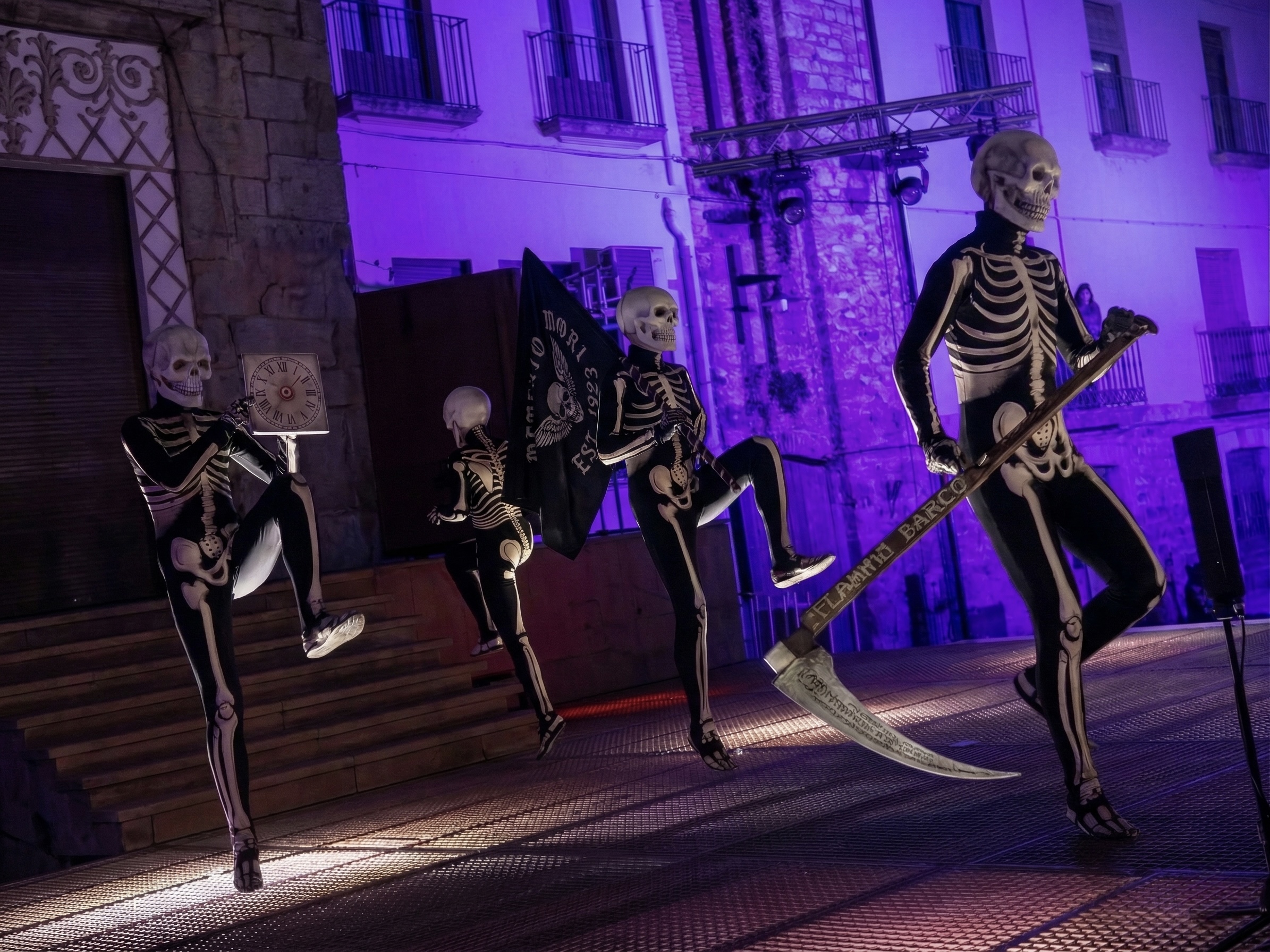

A night procession, torches, five skeletons dancing to the beat of a drum, and a medieval aesthetic that needs no filters and no makeup. As Holy Week experiences go, this is among the most powerful in all of Catalonia.
This is no little show staged for tourists. The Dansa de la Mort — the Dance of Death — is part of the Processó de Verges, deep in the Baix Empordà, and that is the key. It doesn’t run separately, it isn’t an add-on for showing off, it doesn’t appear like a special effect tacked on at the end. It belongs to the whole, one more scene in the night. Death walks on stage alongside everyone else.
When darkness falls, the town changes. The streets fill with torches, the drum hits you in the chest, and suddenly you understand why this has been stunning people for centuries. There are no modern spotlights here, no posing. There is shadow, fire, silence and a dry rhythm that seems to come from somewhere far back in time.
An old idea that is still alive here
The so-called “dance of death” was a recurring theme across Europe between the 14th and 17th centuries. Epidemics, fear and the medieval obsession with reminding everyone that life lasts only so long did the rest. Many of those performances vanished over time. The one in Verges did not.
That alone makes it special. But there is another important detail: the town council notes that the first documented record of the Processó dates from 1666, and even then it was described as a custom. In other words: this is no recent invention dressed up as tradition. There are centuries of genuine continuity here.
And as if that needed sealing, the Processó de Verges was recognized by the Generalitat as a Traditional Festival of National Interest in 1983 and as a Heritage Festival of National Interest in 2010.
Five skeletons and zero subtlety
The best thing about the Dansa is that it doesn’t settle for “looking eerie”. Everything has intent. Everything carries a message. And the medieval message, as you might expect, doesn’t bother with niceties.
The town’s website explains that the Dansa currently features ten characters: five dynamic and five static. The ones that stay burned into your memory are the five dancing skeletons.
La Dalla, who carries the scythe, leads. He is the capdanser, the head dancer. On his scythe appears the phrase Nemini Parco: I spare no one. It doesn’t get clearer than that.
La Bandera carries the black flag with the skull and the warning that time is short. Medieval, yes. Fools, no.
Then come the Platets, two child skeletons carrying ashes, a reminder of how everything ends.
Closing the group is the Rellotge, another child skeleton with a clock that has no hands. The idea is simple and devastating: you don’t know when your turn comes. It could be any moment.
And the drum isn’t there for decoration. It sets the pace of the Dansa with a sound that doesn’t accompany: it strikes.
When it takes place
The Processó de Verges is held every Maundy Thursday, so the date shifts with Holy Week.
In 2026, for instance, it falls on April 2. The official schedule opens at 5:30 pm with the parade of les Manages, continues at 9:30 pm with the performance of the Misteri in the Plaça Major, and carries on at 11:30 pm with the procession through the streets of the town.
And let’s be clear about one thing: this is not an activity to drop in on and head home early. It runs long, it lives by night, and that is precisely why it wins.
The route, and the moment Verges seems to step out of another century
The procession begins and ends at the church square. It winds through different streets of the town, and scenes from the Passion are performed at several points. The route varies in small details from year to year, but certain spots concentrate most of the atmosphere.
The most famous is the Carrer dels Cargols, the Street of the Snails. The name is no accident: it is lit by snail shells stuck to the walls, filled with oil and fitted with wicks. It is one of those old, humble, brilliant ideas that achieves a stunning visual effect without any technology at all.
There the town stops looking like a stage set and starts looking like something else: a corner suspended outside time. Small flames, narrow walls, trembling shadows, and the drum advancing as if it had come to remind you that everything passes.
The ending has power too. The Processó culminates with the crucifixion in the church square and with the Dansa de la Mort bowing before the Blessed Sacrament. That is what keeps the whole thing from being mere spectacle: there is theater here, yes, but also rite and memory.
Why it makes such an impression
Because it doesn’t try to be likable. It doesn’t aim to be charming. It softens nothing. The Dansa de la Mort of Verges works because it preserves that old harshness that almost never survives intact today: the idea that time is running, that no one is spared, and that death makes no distinction of age, status or excuses.
And it does it well, on top of that. With an immensely powerful image, with a staging that the night turns into something almost unreal, and with an entire town upholding a tradition that doesn’t feel manufactured, but genuinely inherited.
Plenty of Holy Week celebrations are worth seeing. This one plays in another league. If you are after something beautiful, dark, ancient and with personality to spare, Verges does not disappoint.
Sources
- Ajuntament de Verges – La Processó de Verges
https://verges.cat/coneix/ruta-historica-i-punts-dinteres/la-processo-de-verges/ - Ajuntament de Verges – Information on the Processó
https://verges.cat/la-processo/informacio/ - La Processó de Verges website – La Dansa de la Mort
https://laprocesso.cat/pages/la-dansa-de-la-mort - Patrimoni Cultural – Generalitat de Catalunya
https://patrimoni.gencat.cat/es/coleccion/procesion-de-verges - Agenda Cultural – Generalitat de Catalunya
https://agenda.cultura.gencat.cat/ca/activitat.html/20260316014/processo-de-verges-amb-la-dansa-de-la-mort - Govern de la Generalitat – press note on the Dansa de la Mort de Verges
https://govern.cat/salapremsa/notes-premsa/402722/la-dansa-de-la-mort-de-verges-arriba-avui-a-tot-el-pais-gracies-a-l-alianca-entre-la-ccma-i-el-departament-de-cultura - Turisme de Catalunya
https://www.catalunya.com/ca/continguts/esdeveniments-agenda/la-processo-de-verges-amb-la-dansa-de-la-mort-1-1-423

Every new chronicle, straight to your inbox
Legends, mysteries and hidden history of Catalonia, straight to your inbox. No noise.
0 comments