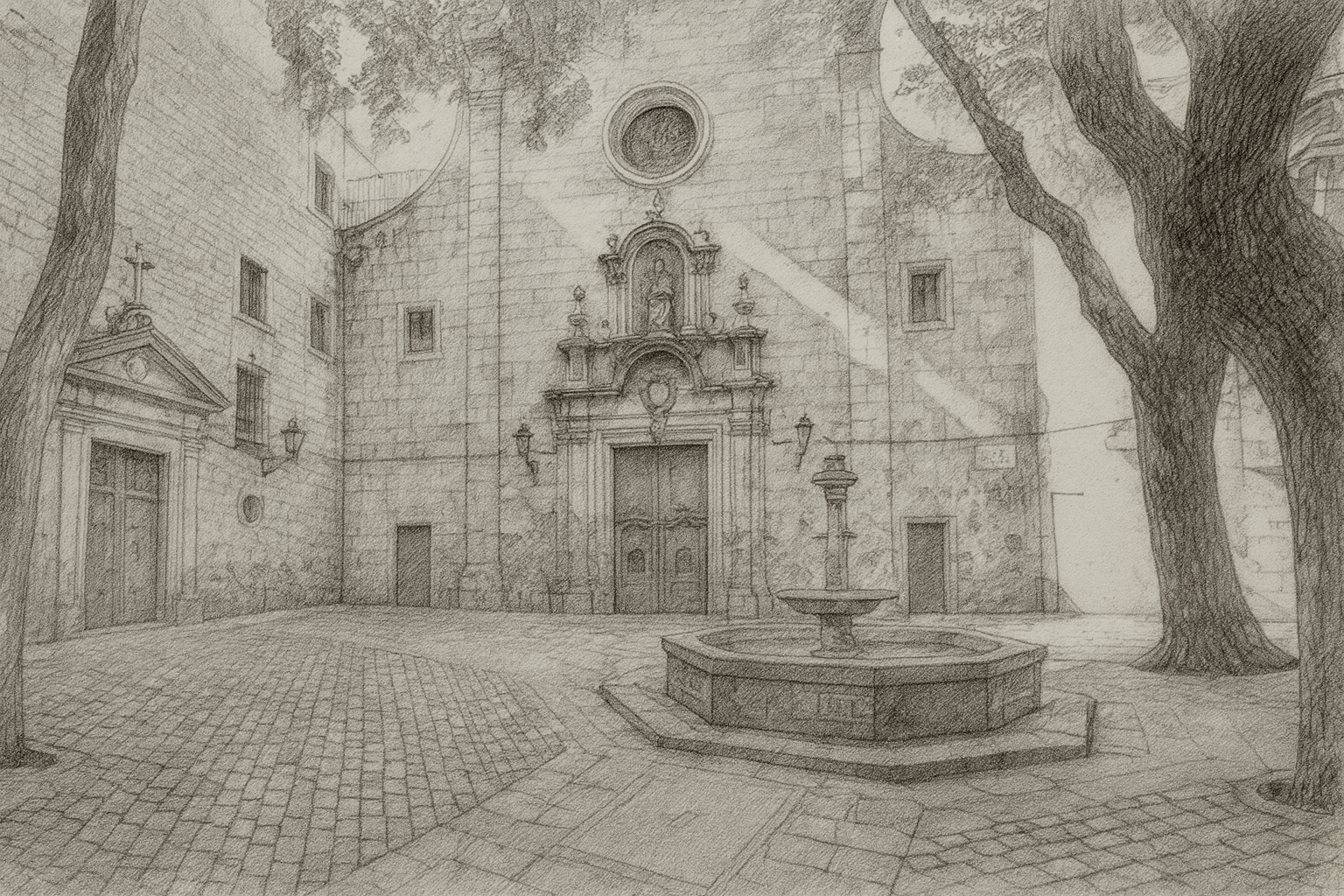

Plaça Sant Felip Neri, in the heart of Barcelona’s Gothic Quarter, is one of those corners where beauty and mystery mix in equal measure. By day everything seems calm: the trees give shade, the fountain murmurs softly and the atmosphere invites you to sit for a while. But when night falls, the air changes. Many swear the silence is broken by whispers and distant laughter, as if something were hiding within the walls. Neighbours and visitors alike claim to have seen small silhouettes and heard children’s voices playing in the half-light. In a place marked by tragedy, it is not hard to imagine that echoes of the past still ring out
A corner scarred by war
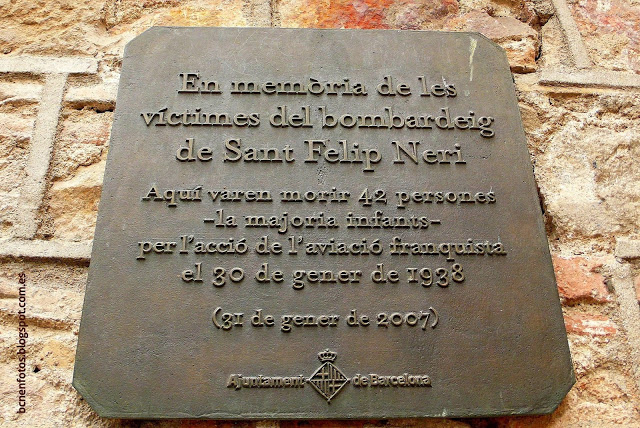
The façades of Sant Felip Neri are pitted with dozens of holes that catch the eye of anyone who steps into the square. They are no ordinary damage: they are the scars of a bombing that took place on 30 January 1938, at the height of the Spanish Civil War. That day, the Italian fascist air force, allied with Franco, dropped bombs on Barcelona, and two of them fell here, on what was then a makeshift shelter for children.
The explosion was brutal: 42 people died, most of them children who had taken refuge in the church basement. The surrounding houses were wrecked and fragments of shrapnel embedded themselves in the walls, where they can still be seen today.
For a long time it was said that those holes were the traces of firing squads, but the truth is even harder: they were not bullets, but bombs. In fact, the square did not even exist as such before the war (it was the church courtyard and an old medieval cemetery), and it was rebuilt in the 1950s.
Today, a simple plaque on the wall remembers the victims, making the visitor pause for a moment and think about the horror this corner once hid, as beautiful as it is wounded
Whispers from the past at night
Despite the serene appearance of Sant Felip Neri, many locals insist the square never falls completely silent after dark. Some say that on quiet nights you can hear soft laughter, small footsteps and even children’s games echoing off the cobblestones, as if the little ones were still there, oblivious to the tragedy that took their lives.
Some witnesses speak of brief whispers and invisible presences: a gust of cold air that seems to run right past you, the echo of a little voice cut short, or the fleeting glimpse of what they believe is a child hiding behind the fountain
It is no coincidence that mystery-tour guides always include this square on their routes: more than one claims to have seen spectral figures in the gloom between the street lamps. For many, there is no doubt that the innocent souls of those children remain somehow bound to this place, filling it with a supernatural melancholy while Barcelona sleeps.
The legend of the skeleton invited to dinner
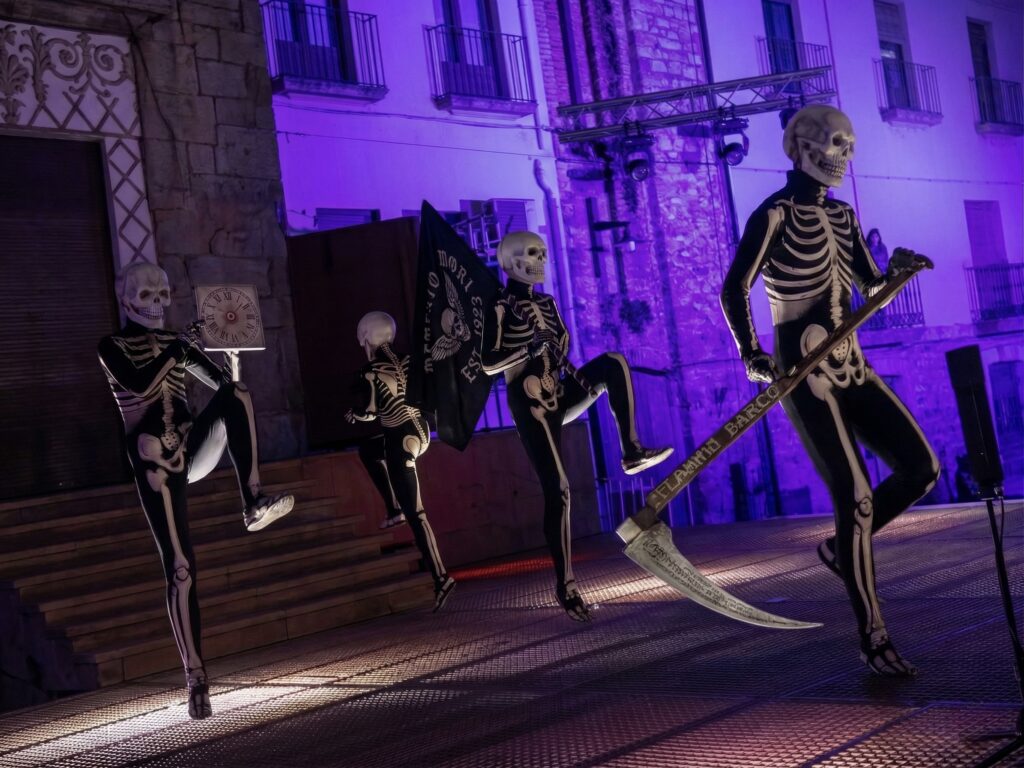
The mysterious atmosphere of Sant Felip Neri does not come from the war alone. The square sits on the old Fossar de Montjuïc del Bisbe, a cemetery that until the late nineteenth century was the burial ground of bishops, nobles and those condemned to death. That dark past gave rise to a macabre legend handed down among Barcelonans. The story goes that, back in those days, two well-to-do young men left a nearby tavern one night and decided to cut across the old graveyard. One of them, hoping to impress, picked a human skull up off the ground and, laughing, held it aloft like Hamlet, cracking macabre jokes. So sure of himself was he that he even “invited” the skull to dinner at his house before kicking it away, boasting of his bravery. A few hours later, however, once he was home, there came three knocks at the door. When he opened it, the reckless joker found himself face to face with a skeleton holding that very skull in its hands. “Did you invite me to dinner?” the apparition asked. The young man dropped dead on the spot. Ever since, it is said his soul rests (perhaps uneasily) in the very cemetery where it all happened. Stories like this fed the supernatural aura of Sant Felip Neri long before the tragedy of 1938, reinforcing the feeling that in this square the past never quite dies.
Memory and mystery in Sant Felip Neri
Today, Sant Felip Neri is a study in contrasts within the Gothic Quarter: busy with tourists and neighbours, yet charged with energies and memories. At midday the schoolchildren play and the water of the fountain keeps the calm company; nothing hints at the secrets these walls hold. At dusk, when the square empties, the line between history and legend blurs. The scars in the stone bring back the horror of the war, and the tales of apparitions and voices invite you to imagine that spirits of other times still wander beneath the lamps. Sant Felip Neri is, in short, a place where the tragic and the inexplicable live side by side. Whoever strolls through the Gothic Quarter does not just discover Barcelona’s memory; they may also hear the whisper of its mysteries.
Key references:
- Wikipedia – Plaza de San Felipe Neri (Barcelona): historical facts about the square and the 1938 bombing: es.wikipedia.org.
- Tot Barcelona – Las cicatrices de Sant Felip Neri, historia de una barbarie: an account of the bombing and its aftermath (Jordi Subirana, 2025): totbarcelona.cattotbarcelona.cat.
- Tot Barcelona – Una calavera i tres façanes “falses”: les vides de Sant Felip Neri: article by Mireia Pons on the skeleton legend and the old cemetery’s past (in Catalan): totbarcelona.cattotbarcelona.cat.
- Hoy Barcelona – Un viaje por las leyendas del Barrio Gótico: a journalistic piece mentioning the alleged apparitions of children in Plaça Sant Felip Neri: hoybarcelona.app.
- Icono Barcelona Tours – Fantasmas de Barcelona: Lugares embrujados y sus misterios: a tourism blog that lists Sant Felip Neri among the city’s spots with spectral figures: iconobarcelonatours.com.
- Wikiloc (the “Barcelona Oculta: Misterios y Leyendas Negras” route) – an urban route description gathering neighbours’ accounts of whispers and children’s footsteps in Sant Felip Neri: ca.wikiloc.com.
Keep reading
Every new chronicle, straight to your inbox
Legends, mysteries and hidden history of Catalonia, straight to your inbox. No noise.
0 comments