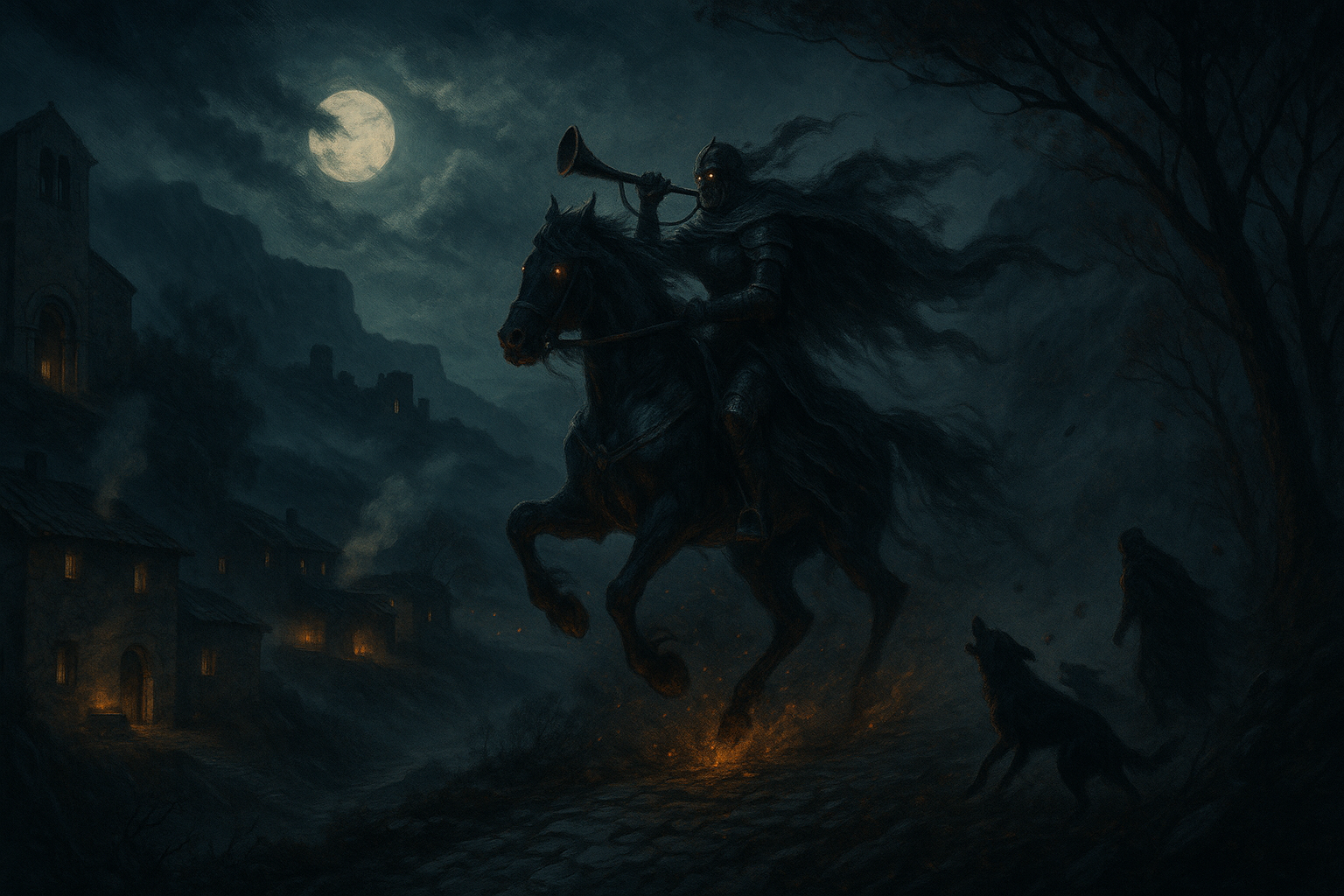

In the heart of the Ripollès, as the Nit de les Ànimes (Night of Souls) draws near, an ancestral atmosphere settles over the county. Houses light candles to guide the dead home, the air fills with the scent of roasted chestnuts, and the old paths, like the one linking Montgrony and Mataplana, seem to sink into mystery. It is on this magical night, so the legend goes, that Comte Arnau — Count Arnau — returns on his eternal ride.
The oldest villagers tell it in hushed voices: if you hear the distant sound of a horn and the desperate howling of dogs, it is time to take shelter. Sometimes it is only the wind coming down the valley, shaking the branches; other times, even with the moon lighting the landscape, the forest seems to guard a dark presence.
The Origin of the Legend: Between History and Myth
The figure of Comte Arnau is one of the oldest and most deeply rooted legends in Catalunya, born among these very valleys. Its origin is tied to a historical figure, Arnau de Mataplana, an eleventh-century nobleman known for his tyranny and abuses of power.
Over the centuries, oral tradition, through songs and folk tales, turned the feudal lord into a soul in torment. A romantic, tragic thread was woven into the story: his forbidden love for an abbess of the monastery of Sant Joan de les Abadesses. That sin, together with his unpaid debts and his cruelty, sealed his fate: to ride for all eternity without ever finding rest. The famous folk ballad of Comte Arnau spread his story across Catalonia, and it was later immortalised by great writers such as Joan Maragall.
What Happens on the Night of Souls? The Infernal Ride
Popular tradition describes the count’s appearance in precise detail. He is said to emerge from the Gorg dels Banyuts (the Pool of the Horned Ones) in Gombrèn and tear through the forests at supernatural speed. The apparition follows a strict order:
- The sound of the horn: A lone echo announcing his arrival.
- The howling of his dogs: A ghostly pack that rides with him.
- The infernal gallop: A thunder of hooves that seems to belong to another world.
Those who dare to look swear they see a reddish glow between the trees, like embers dancing in the darkness. Others describe a gust of icy air cutting right through them, the unmistakable sign that the spectre has just passed by. The warning is unanimous: when you hear him coming, shut your doors and windows. Just before dawn, a rooster crowing on the Cresta del Gall breaks the spell, and the count fades away until the following year.
A Myth That Endures: The Mark of Comte Arnau Today
Far from fading away, the legend of Comte Arnau is more alive than ever. It has inspired poets, musicians and artists, and has become a cultural emblem of the Ripollès. Every summer, the town of Sant Joan de les Abadesses stages a music and theatre show that recreates the myth with torches, drums and horses, filling the square and bringing the old ruins back to life.
For anyone who wants to walk the legend’s territory, a visit to the Museu del Comte Arnau in Gombrèn is essential. From there it is easy to trace the horseman’s route: the ruins of his castle, the paths he rode and the pools where, they say, his soul remains trapped.
Memory and Mystery in the Heart of Catalunya
The Night of Souls in the Ripollès is much more than a simple ghost story. It is a direct connection with the past, an act of collective memory. Comte Arnau keeps riding because his figure embodies universal themes: guilt, punishment and a past that refuses to be forgotten.
Perhaps that is why his gallop still makes the skin prickle. Because when the wind blows through the mountains and the full moon rises over the valley, it is easy to feel the count passing by, leaving behind only the echo of his eternal sentence.
Key references:
- Conde Arnau – Wikipedia (Spanish): origins of the legend, the ballad and versions of the myth.
https://es.wikipedia.org/wiki/Conde_Arnau - Festes.org – “Tots Sants o Festa dels Morts”: customs of All Saints’ night in Catalunya (lights for the souls, cemetery visits).
https://www.festes.org/ca/articles/view.php?id=213 - ABC (Mónica Arrizabalaga, 2015) – “El diabólico conde Arnau…”: a tour of the legend (Gorg dels Banyuts, the rooster’s crow, the night hunt) and the link with Arnau de Mataplana.
https://www.abc.es/cultura/20150604/abci-diabolico-conde-arnau-colaba-201506021328.html - Fantasía Celta (David Tebras) – “El Conde Arnau: el alma en pena más famosa de Cataluña”: a summary of the myth (flaming horse, dogs, ghostly retinue and night-time fear in the Ripollès).
https://www.davidtebras.com/FantasiaCelta/el-conde-arnau/ - Ajuntament de Sant Joan de les Abadesses (2015) – “Les ànimes del comte”: municipal note with the warning of the horn and the howling; cultural event about the myth.
https://www.santjoandelesabadesses.cat/index.php/es/la-vila/noticias-lavilla/2020-les-animes-del-comte-l-espectre-del-comte-arnau-i-la-processo-d-esperits-condemnats - Museu del Comte Arnau: local information.
https://www.elripolles.com/que-vols-fer/turisme-cultural/museus-i-centres-dinterpretacio/museu-del-comte-arnau/51.html
Keep reading
The Legend of Siurana

The Legend of the Pedraforca
Every new chronicle, straight to your inbox
Legends, mysteries and hidden history of Catalonia, straight to your inbox. No noise.
0 comments