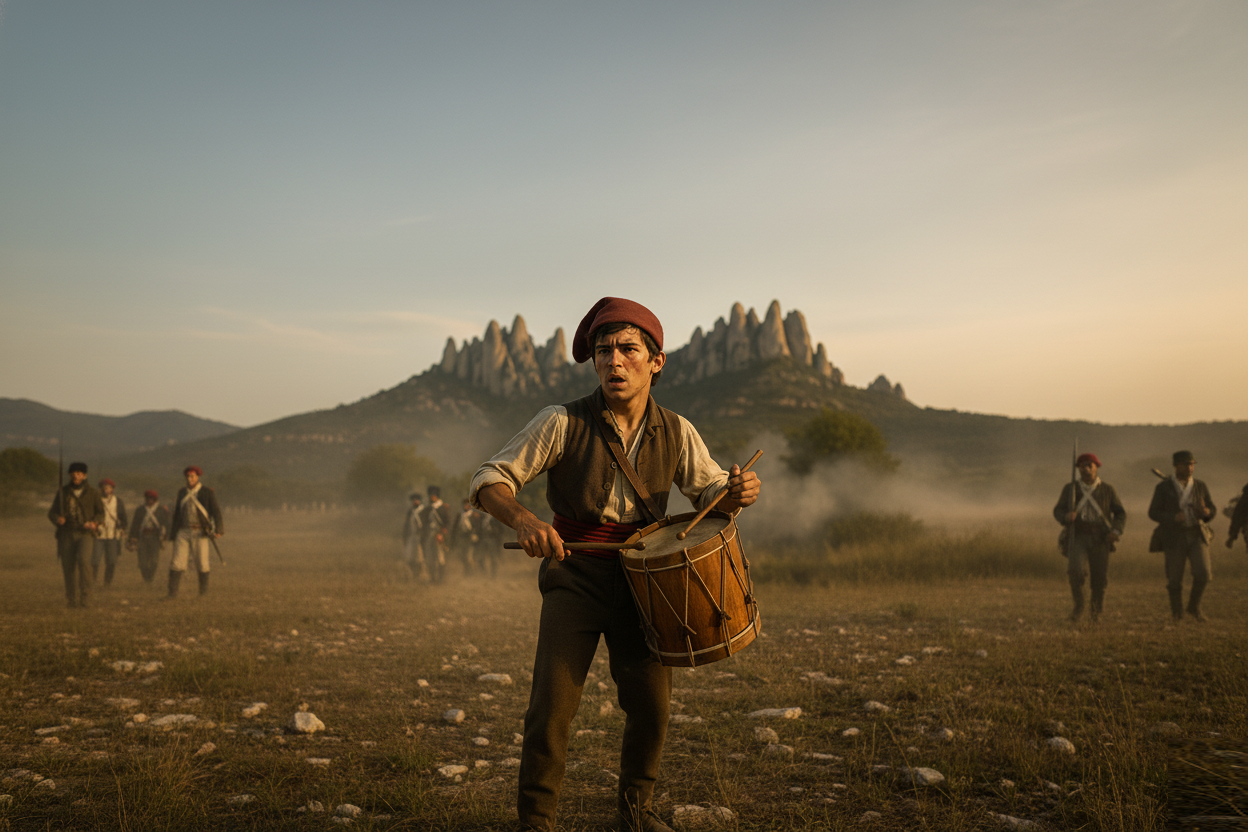

Among the rocks of Montserrat rolls the beat of a lone drum; the mountain throws it back again and again, multiplying the sound until it fills the valley. The path, silent a moment before, suddenly rumbles with the murmur of war. On the trails below the mountain, the French troops halt their advance and exchange uneasy glances. What they had heard as a single drum now sounds like a hundred, as if an army hidden behind the crags were rising to meet them. For a moment, Napoleon’s invincible empire hesitates.
The Battle of El Bruc: the history behind a legend
The events that gave rise to this scene took place on June 6, 1808, at the height of the Peninsular War. That day, a column of some 3,800 Napoleonic soldiers was marching from Barcelona into inland Catalonia with orders to crush the uprisings in Manresa and Igualada. In the pass of El Bruc, beside the mountain of Montserrat, something unexpected was waiting for them: around 2,000 Catalans — armed peasants (the sometent, the local militia) and volunteers from the area — had laid an ambush. The French were stopped dead and forced to retreat toward Barcelona with heavy losses. A few days later, on June 14, a second French attempt with more than 5,000 men under General Joseph Chabran ended in defeat as well. These victories shattered the myth of the Napoleonic army’s supposed invincibility and became a symbol of Catalan resistance against the invader.
News that poorly armed volunteers had beaten the finest army in Europe spread like wildfire. An epic tale soon emerged to explain the improbable feat. As early as September 1808, newspapers of the day recounted the battle of El Bruc, stressing that the Catalan people had fought “with their own forces alone, without cavalry, artillery or military command…”. In 1809, one chronicler went so far as to write of “a young man from Santpedor raised to commander-in-chief” of the revolt. Thus began the legend of the Timbaler del Bruc — the drummer boy whose cunning and courage were said to have tipped the scales of history.
The young drummer of Santpedor and the echo of Montserrat
According to the legend, at the fiercest point of the battle a young Catalan began to beat his drum with all his strength. The sound of each drumroll bounced off Montserrat’s rock walls and was amplified as if by magic. The French, confused, had the impression that a far larger army was approaching than actually existed, and panic swept through their ranks. Believing they faced a mass of enemy reinforcements, the invaders chose to turn around and flee downhill, pursued by the local defenders. That ingenious thunder is said to have saved the day.
The hero of this popular feat is identified as Isidre Lluçà i Casanoves, a 17-year-old from Santpedor (near Manresa). Isidre is said to have accompanied the El Bruc militias and, armed with nothing but a drum (possibly lent by his town’s confraternity), achieved the impossible. His bravery was immortalized: the figure of the young drummer gained prominence throughout the 19th century until he was presented as the chief architect of the victory at El Bruc. In fact, there are hints that the Timbaler was not invented out of thin air: period documents mention the “famous Drummer of El Bruc” parading through Santpedor just months after the battle — a sign that the boy hero already held a place in the Catalan collective imagination.
An echo that endures: monuments and the Timbaler trail
In the town of El Bruc, at the foot of Montserrat, a grand monument to the Timbaler del Bruc stands today in memory of the feat. It is a 2.2-meter bronze sculpture by the celebrated artist Frederic Marès, unveiled in 1952 at the height of the Franco regime. The statue shows the young drummer in a defiant pose, drum ready to sound once more. On the pedestal, an inscription still challenges the passing traveler: “Stop here, for the Frenchman stopped here too; he who passed through everything could pass no further than this”. It is not the only tribute: in Santpedor, his hometown, and even in Barcelona there are plaques and sculptures dedicated to the brave drummer. Every year in early June, El Bruc celebrates the Festa del Timbaler with historical reenactments, blunderbuss salvos and drums, keeping the legendary memory of 1808 alive.
The Timbaler’s mark endures not only in bronze and festivals but in the very mountain that made him legendary. In 2013, a team of researchers from the University of Barcelona managed to identify the exact spot where, according to tradition, Isidre sounded his drum. The study placed it below the hill of Les Torres de Can Maçana, a strategic pass beside the Montserrat massif. It was from there that the militias launched their surprise counterattack, and it is believed to be where the echo would have had its greatest effect. Using modern sound equipment, the experts measured the valley’s acoustics to determine how far the terrain could have amplified the drumroll. The first results were promising: they confirmed that sound reverberates through these mountains, producing audible echoes at several points of the old battlefield.
Anyone wishing to relive the legend can literally follow in its footsteps. There is now a signposted Path of the Battles that crosses the town of El Bruc and climbs to the Can Maçana pass, through the very landscape where the fighting took place. The route passes right in front of the Timbaler monument and offers, as it rises, magnificent views of the Montserrat range. On reaching the pass, you find yourself surrounded by the towering rock walls at the heart of the story. If the day is calm, just clap your hands hard… and wait. A second later, the echo returns the blow, clear and sharp. It is the echo of Montserrat, which to this day repeats the sound of the drum for anyone who cares to listen — the same echo that, the legend says, frightened Napoleon.
Key references:
- DIBA Festive Archive – “Battles of El Bruc, June 1808”: historical summary of the events and the making of the legend.
- Catalunya M’agrada – “Do you know the story of the Timbaler del Bruc?”: the popular tale of the Timbaler, with details of the Frederic Marès monument.
- University of Barcelona (News, 2013) – “Research into the legend of the Drummer of El Bruc”: locating the echo point below the Can Maçana pass and an acoustic recreation of the drum.
- Wikipedia (es) – Tambor del Bruch: historical context of the battles and the figure of Isidre Lluçà i Casanoves.
Keep reading

Every new chronicle, straight to your inbox
Legends, mysteries and hidden history of Catalonia, straight to your inbox. No noise.
0 comments