
Some places feel completely harmless during the day. A path, a stretch of woodland, a few stones and not much else.
Then late October arrives, darkness comes earlier, and somehow everything feels a little different.
In Santa Maria de Martorelles, in the Vallès Oriental region, there is one of those places.
It is called Castellruf.
The legend itself is surprisingly simple.
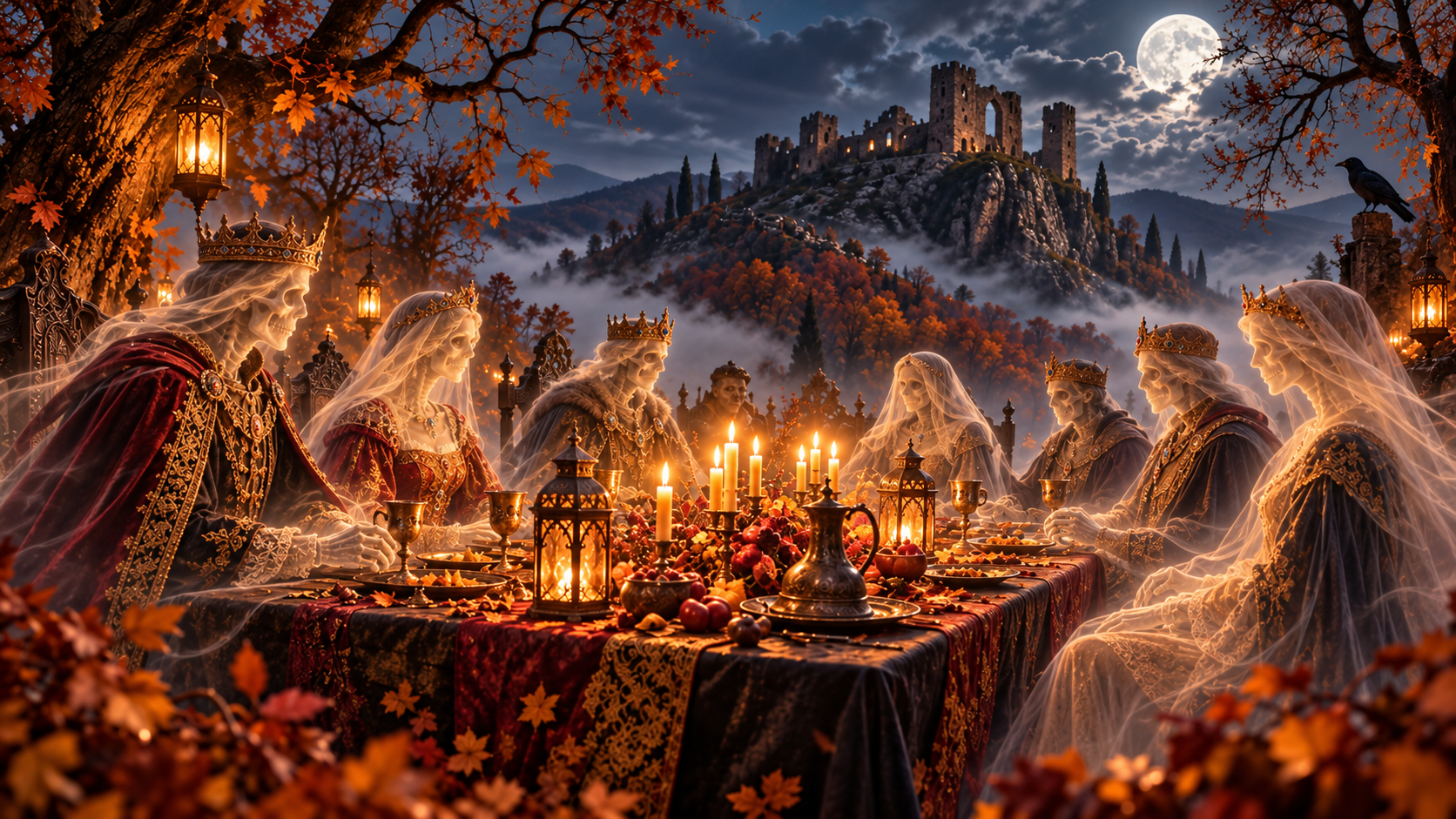
On All Saints’ Night, the former inhabitants of a long-vanished castle are said to return to the top of the hill. Men and women gather once again around a table and share a meal without speaking a single word.
So far, strange enough.
The real problem is what lies beneath their clothes.
According to the legend, beneath those elegant garments there is nothing left but bone.
The legend of Castellruf
This is not an internet ghost story, nor one of those legends that somehow gains three new spirits, an EVP recording and a girl in a white dress every time somebody retells it.
The Llegenda de Tots Sants a Castellruf is officially recorded in the Cultural Heritage Map of the Diputació de Barcelona as part of the oral tradition of Santa Maria de Martorelles.
And the version that has survived really does not need much embellishment.
The former owners of the castle return during All Saints. They climb the hill, sit around a table and eat in complete silence. They are dressed as they were in life, but beneath those clothes there are no longer living bodies.
Only bones.
The legend was recorded by Catalan folklorist Joan Amades in 1950, in Folklore de Catalunya. Rondallística. It later appeared in other works dealing with the legends and castles of the Vallès Oriental.
And this is one of those cases where it is better not to add anything.
I have found no original sources mentioning screams in the night, mysterious lights or hikers being chased through the woods by skeletons.
It would certainly make a good story.
But we would be making it up.
The castle was real
What makes the story more interesting is that Castellruf Castle really did exist.
It once stood on the hill of Castellruf, roughly 457 metres above sea level. The castle appears in documents as early as 1018, under the name castrum Radulfus. It is mentioned again in 1060 as castro vocitato Radolph.
During the Middle Ages it changed hands several times and was closely connected to the territory that is now Santa Maria de Martorelles.
Then it disappeared.
And in this case, “disappeared” is quite literal.
Today there are no visible structures that can be clearly identified as remains of the medieval castle. Archaeological work has also failed to locate its ruins with certainty, although that does not necessarily mean that nothing survives beneath the ground.
Something much older does remain on the same hill: the Iberian settlement of Castellruf, occupied roughly between the fourth and first centuries BC.
Archaeologists have documented traces of houses, defensive walls, hearths and other parts of the settlement.
People, then, had been living on this hill for centuries before anyone decided to build a medieval castle there.
And for many more centuries before the dead supposedly began returning for dinner.
All Saints was once much darker
The fact that the banquet takes place specifically during All Saints is probably no coincidence either.
Today, the Catalan Castanyada brings to mind roasted chestnuts, panellets, sweet potatoes and perhaps a glass of muscatel wine.
But traditionally there was something rather darker behind it all.
All Saints’ Day and the Day of the Dead were closely linked to the memory of the deceased and to an old belief that, on those nights, the boundary between the living and the dead became somewhat less certain.
Different Catalan traditions included lighting candles, keeping the household fire burning and leaving food for deceased relatives. There are also references to preparing a place for them at the family table.
Chestnuts, panellets and other foods associated with this time of year were likewise connected for centuries with remembrance of the dead.
Seen in that context, the Castellruf legend begins to make rather more sense.
If people believed the dead could return home for a night, it was not such a great leap to imagine the former lords of a castle returning to theirs.
Even if the castle itself was already gone.
We do not know exactly when the legend began. Nor do we know who first told it, or which former owners local people imagined sitting around that silent table.
We probably never will.
What we do have is a documented medieval castle, an even older Iberian settlement, a Catalan tradition deeply connected with the return of the dead, and a story that Joan Amades chose to write down before it disappeared altogether.
It does not need paranormal investigators or recordings of ghostly voices.
The image is unsettling enough on its own.
A wooded hill. A castle that vanished centuries ago. And one night every year when its former inhabitants return to sit around a table whose location has also been forgotten.
And they eat in silence.
That might be the worst part.
So if you ever find yourself walking through Castellruf on All Saints’ Night and happen to see a table laid among the trees…
I would check who is sitting there first.
And, more importantly, whether any of them still have flesh on their bones.
References:
- Diputació de Barcelona — Llegenda de Tots Sants a Castellruf (main institutional source for the legend): https://patrimonicultural.diba.cat/element/llegenda-de-tots-sants-a-castellruf
- Diputació de Barcelona — Castell de Castellruf (historical documentation on Castellruf Castle): https://patrimonicultural.diba.cat/element/castell-de-castellruf
- Diputació de Barcelona — Poblat ibèric de Castellruf (archaeological information on the Iberian settlement): https://patrimonicultural.diba.cat/element/poblat-iberic-de-castellruf
- Ajuntament de Santa Maria de Martorelles — Història (local historical context): https://www.santamariademartorelles.cat/el-municipi/informacio-del-municipi/historia
- Generalitat de Catalunya — Costums i tradicions (traditions surrounding All Saints, the dead and the Castanyada): https://drac.cultura.gencat.cat/bitstream/handle/20.500.12368/35990/Costums%20i%20tradicions.pdf
- Enciclopèdia Catalana — Tradicionari: La tardor (ethnographic background on All Saints and traditional beliefs concerning the dead): https://www.enciclopedia.cat/tradicionari/la-tardor
If this one stayed with you, light a candle for it.
Keep reading
Every new chronicle, straight to your inbox
Legends, mysteries and hidden history of Catalonia, straight to your inbox. No noise.
Controller: Marc Rodríguez Limpangog. We use your details only to tell you about each new story, and every email lets you unsubscribe. Your rights and the full details are in the privacy policy.
0 comments