
There is not much about the Castanyada today that feels particularly unsettling. Hot roasted chestnuts, panellets, sweet potatoes, muscatel wine and children dressed as the traditional castanyera at school. At most, there might be the usual argument about whether Halloween is slowly taking over.
A few centuries ago, things looked rather different.
Because Tots Sants — All Saints’ Day — was not simply a time to remember the dead. It was also a time when they were believed to come back.
And meeting them on the road was probably best avoided.
When the dead came home
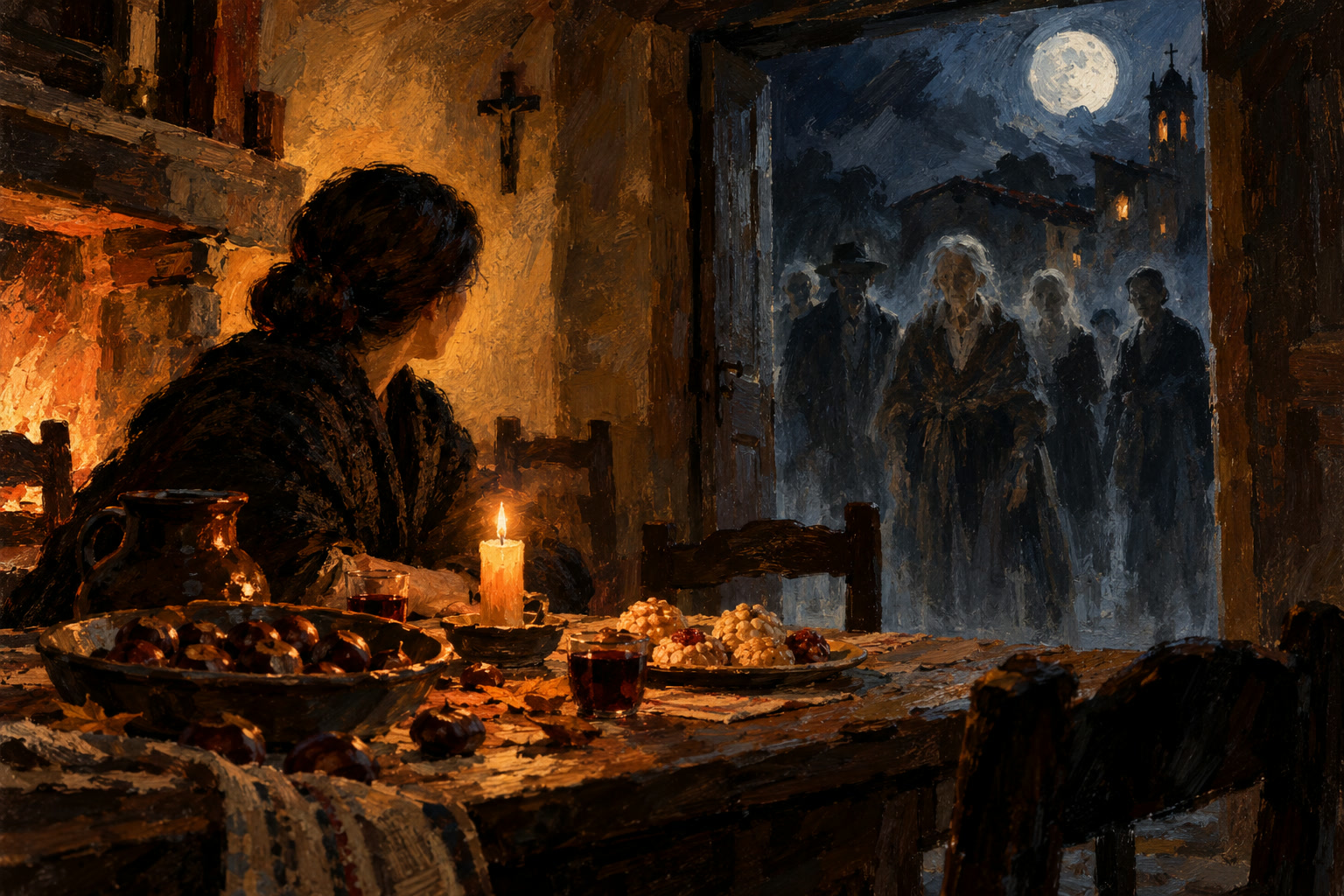
For generations in Catalonia, people believed that during Tots Sants the souls of the dead could temporarily return to the world of the living. Not as zombies or anything quite so dramatic. These were the souls of relatives and ancestors returning to the homes where they had once lived.
Folklorist Apel·les Mestres recorded a fairly specific version of the belief: the souls left Purgatory on the afternoon of Tots Sants, spent the night alongside their families and returned the following day. In some places, households prepared for their arrival.
Candles or oil lamps were lit to remember the dead and help guide them home. Some families placed an extra plate on the table for the most recently deceased member of the household, prepared their bed and even kept the fire burning throughout the night.
I do not know about you, but preparing the bed changes the modern image of the Castanyada quite a bit.
The idea itself was simple. For that one night, the dead might once again be among their family. And if they came home, they were treated as part of the household.
Outside, things could feel rather less welcoming. Church bells rang for the dead and some traditions encouraged people to remain gathered around the fire. Walking along lonely roads after dark was not always considered a particularly good idea. You might encounter one of the wandering souls.
Joan Amades even recorded a rather peculiar superstition: while the bells were tolling for the dead, you were not supposed to look into a mirror. According to the belief, anyone who did might see their own face transformed into a skull.
Probably not something worth testing.
Bells, chestnuts and an extra plate
This is where the chestnuts come in.
The connection between the Castanyada and the dead runs much deeper than it may seem today. Documentation from the Generalitat de Catalunya notes that chestnuts, sweet potatoes and panellets, now eaten as part of the celebration, once had associations with offerings made to the dead. There were also so-called pans d’ànimes — “breads of the souls” — small breads or sweets linked to religious observances for the deceased.
And then there were the bell ringers.
During the nights around Tots Sants and the Day of the Dead, church bells could toll for hours, reminding people to pray for those who had died. Tradition holds that bell ringers ate chestnuts and drank wine to keep their strength up through the long night. It is one of the best-known explanations for the origins of the Castanyada, although it should not be treated as unquestionable fact.
We do not know that two bell ringers simply decided to eat some chestnuts one evening and accidentally invented the celebration.
Its origins are more complicated than that.
What we do know is that by the late eighteenth century, eating chestnuts around Tots Sants was already widespread in Catalonia. Families prayed for their dead, gathered around the fire and remembered those who were no longer there. In some places, bell ringers worked in shifts through the night and were given bread, wine and chestnuts while the bells continued to toll.
For hours.
It is difficult to imagine today, but it must have been a night that was impossible to ignore.
The Castanyada we have forgotten
There is another important detail.
Today, the Castanyada is usually celebrated on the evening of 31 October, the eve of Tots Sants. Many of the older customs directly connected with the return of the dead, however, were associated especially with the period between 1 November, Tots Sants, and 2 November, the Day of the Dead.
Dates and rituals changed over time. The chestnuts remained. So did the panellets and much of the family gathering.
The funerary side of the celebration gradually faded.
Perhaps that is why discovering what once lay behind the Castanyada can feel so surprising.
It was not simply a Catalan version of Halloween. Nor do we need to turn it into some sort of medieval horror story to make it interesting.
It already had its own dead.
There were bells tolling through the night, candles burning for wandering souls, food left for people who were no longer alive and families who genuinely believed their dead relatives might return home for a few hours.
Over time, the celebration changed. The fire stayed. The chestnuts stayed. The dead moved quietly into the background.
But there is one image that is difficult to forget.
A Catalan house two hundred years ago. It is cold outside. The streets are empty and the bells have been tolling for the dead for hours.
Inside, a family sits around the fire eating chestnuts.
And on the table there is one plate that nobody touches.
Because it is not meant for them.
Selected references:
- Enciclopèdia Catalana – Tradicionari: “La tardor” — Beliefs surrounding the return of souls during Tots Sants, the place set for the dead, the prepared bed, the household fire, church bells and the mirror superstition: https://www.enciclopedia.cat/tradicionari/la-tardor
- Enciclopèdia Catalana – Tradicionari: “Els rituals i les festes de foc” — Information on the role of fire and lights during Tots Sants and their connection with remembrance of the dead: https://www.enciclopedia.cat/tradicionari/els-rituals-i-les-festes-de-foc
- Generalitat de Catalunya – Patrimoni Festiu: Tots Sants, la Castanyada — Official information on Tots Sants, the Castanyada, chestnuts, sweet potatoes and panellets: https://patrimonifestiu.cultura.gencat.cat/Tots-Sants-Barcelona-la-Castanyada
- Generalitat de Catalunya – Costums i tradicions — Documentation on November traditions, remembrance of ancestors and the former funerary associations of foods eaten at this time of year: https://drac.cultura.gencat.cat/bitstream/handle/20.500.12368/35990/Costums%20i%20tradicions.pdf
- Institut d’Estudis Catalans – Litúrgia popular — References to prayers for the dead, bells tolling through the night and food provided to bell ringers: https://publicacions.iec.cat/repository/pdf/00000538/00000020.pdf
- Ajuntament de Barcelona – Protocol Festiu de Ciutat Vella — Background on the relationship between the Castanyada, Tots Sants and older funerary customs: https://www.barcelona.cat/culturapopular/sites/default/files/protocol_festiu_de_ciutat_vella_-_web.pdf
- Festes.org – La Castanyada — Background material on bell-ringing traditions, chestnuts and the spread of the custom during the eighteenth century: https://www.festes.org/ca/calendari/festes-de-tardor/217/article/214/la-castanyada
If this one stayed with you, light a candle for it.
Keep reading

Every new chronicle, straight to your inbox
Legends, mysteries and hidden history of Catalonia, straight to your inbox. No noise.
Your data
- Controller
- Catalunya Oculta
- What for
- Telling you about each new story. Unsubscribe from any email.
- Your rights
- See, correct or delete your data: it is all in the privacy policy.
0 comments